
Begin an Ionia County Property Records Search
One page gathers the main entry points. The county's Online Services page links both Parcel Information through BS&A and the Tax Parcel Viewer. Use either to pull the PIN, the owner field, situs, mailing address, and tax geography. Then take the owner name or legal description to the recorder's index. The Register of Deeds will not search by street address, so that conversion comes first.
These records support each other, though none replaces the rest. A GIS line is not a survey. The tax owner can lag a recorded transfer. An index entry is never a title opinion. Keep the same PIN and legal description through every step of the search.
- Locate the parcel by address, owner, or PIN and copy its complete identifiers.
- Search the recorder index by owner or legal description for the relevant deed.
- Check assessment and current or delinquent tax information for the same year and unit.
- Use GIS to understand parcel position, acreage, zoning, and nearby tracts.
- Order a copy or use the courthouse, local office, archive, or FOIA route when online data stops.
Offices Behind Ionia County Property Records
The three principal offices all sit in the courthouse at 100 W Main Street in Ionia. The Register of Deeds keeps recorded land instruments. Equalization backs valuation and parcel resources. The Treasurer holds tax-roll copies along with delinquent-tax records. Published hours run 8:30 a.m.–noon and 1–5 p.m.
Ionia County Recorder / Register of Deeds
100 W Main Street
Ionia, MI 48846
(616) 527-5320
Ionia County Assessor / Appraisal District
100 W Main Street, second floor
Ionia, MI 48846
(616) 527-5376
Ionia County Treasurer / Tax Collector
100 W Main Street, first floor
Ionia, MI 48846
(616) 527-5329
Three Ionia Record Systems Work Together
The parcel and GIS layer gives a search its practical starting identity. From there, the Register of Deeds records over 200 document types. Deeds, mortgages, and releases are among them. So are liens, land contracts, powers of attorney, and plats. Equalization and local assessing units carry valuation and classification duties. Local units collect current taxes, and the county Treasurer handles delinquency.
The handoffs deserve attention. Convert an address to an owner and legal description before touching the deed index. Then tell a true conveyance apart from a mortgage, release, or lien. A recorded instrument can reach the county's tax offices before it shows in a public parcel layer. So track each source's date.
Ionia County's Parcel Viewer and Public Layers
For a visual approach, the Tax Parcel Viewer puts Ionia County parcels on a map. You can pan and query it. The county also publishes a full parcel service behind the scenes. Its fields include Owner Name, PIN, situs and mailing addresses, and acreage. Zoning, Parent Parcel, and Comments round out the schema. Treat any layer date as a maintenance stamp. New deeds reach the tax roll on their own schedule. A recorded deed may not appear in the viewer right away. For the complete field list, inspect the official parcel-layer schema.
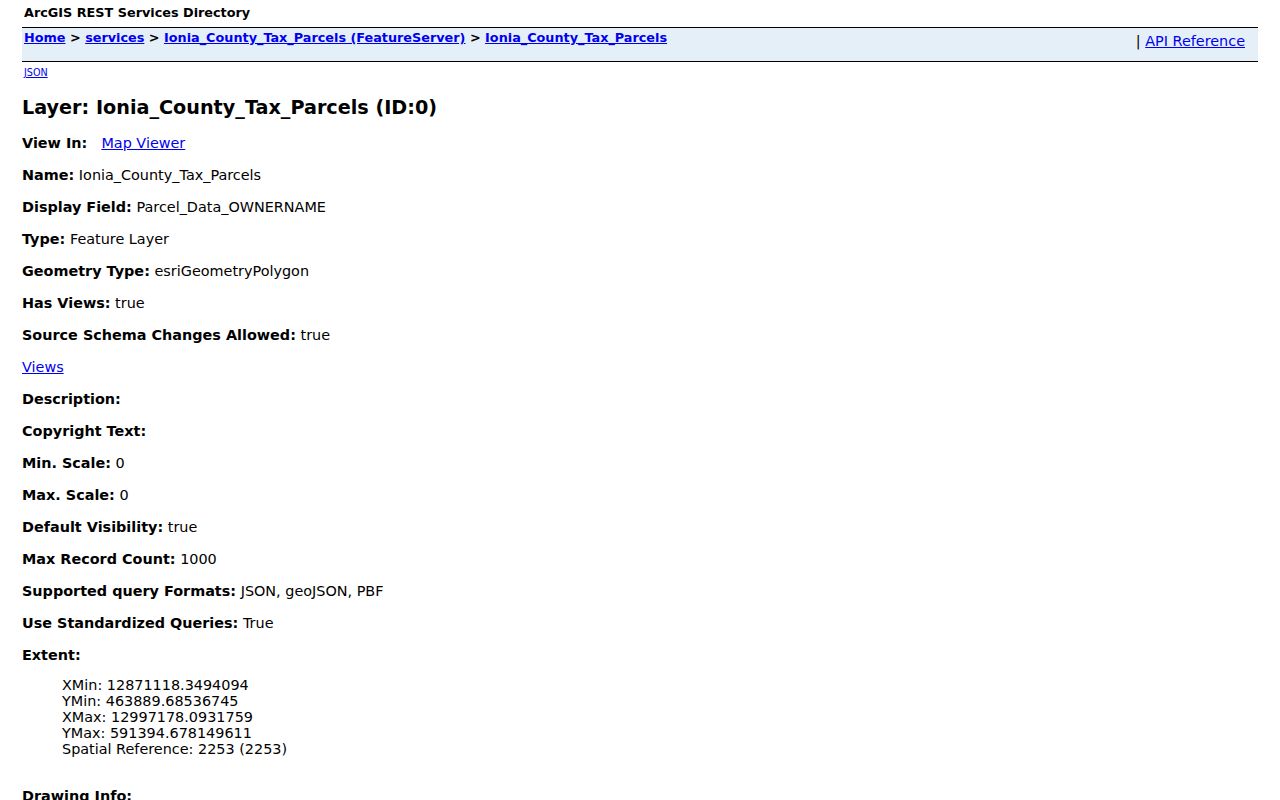
The official parcel-layer schema shows the fields available on each parcel card and offers a reproducible source when the graphical viewer is off limits.
Record Sets Available for Ionia County Property
Match the record type to the fact you need. Deed records prove ownership transfers. Assessment records carry values and tax bases. Maps and plats supply parcel context, and payment status belongs to local collectors or the Treasurer. Disputes can add court records to the trail as well.
| Record Type | What It Documents | Kept By | Access |
|---|---|---|---|
| Deeds and land contracts | Recorded transfers and parties | Register of Deeds | Tapestry, public computers, copies |
| Mortgages, releases, liens | Recorded encumbrance trail | Register of Deeds | Index and instrument copies |
| Assessment and tax | Assessed/SEV/taxable value, PRE, bills | Local assessor, Equalization, Treasurer | Parcel links, reports, office request |
| Plats and parcels | Lots, subdivisions, acreage, map context | Register of Deeds and GIS | Recorded plat and parcel viewer |
| Building and zoning | Applications, approvals, inspections | County or responsible municipality | Office files and planning pages |
Turn to Ionia County deed records for recorded proof, property tax records for assessment and tax detail, and parcel maps for mapped geography.
Read Ionia Assessment Values in Context
Michigan assessment records separate four numbers. Assessed value, state equalized value, taxable value, and true cash value each mean something distinct. Assessed value and SEV generally stand at 50 percent of true cash value. Taxable value is a separately capped base. A transfer can uncap taxable value in the following calendar year, subject to statutory exceptions. Recorded consideration is yet another figure. It should never stand in for a tax value.
The Equalization office posts annual equalization reports covering 2012 through 2026. It also posts apportionment reports from 2014 through 2025. Those documents report unit and class totals rather than any individual parcel card. PRE affidavits, transfer affidavits, assessor contacts, map requests, and address resources all route there too.
Follow Ionia Deeds Beyond the Address
The Register of Deeds asks address-based researchers to start elsewhere. Get the taxpayer name or legal description first. Then search the land-record index by those keys. The generic Tapestry search fields cover party names. They also cover instrument number and type, date range, consideration, subdivision, lot, and block. Ionia does not publish the earliest online year. It does not state the exact reach of its image coverage. Confirm coverage with the office before paying for a search.
At the courthouse, public computers and staff location help offer another channel. Copy costs are posted at $1 per page. A certified document costs $5, and online transactions cost $2. All fees are subject to change. Documents arriving after 4 p.m. are recorded the following business day.
Note: A mortgage, release, lien, or power of attorney belongs to the record trail. It does not by itself change ownership.
Avoid Ionia Deed-Copy Solicitations
Unofficial letters have offered Ionia County deed copies. The asking price reached $89. The official copy rate is just $1 per page. The county's Register of Deeds guidance explains how to identify the correct instrument. It also covers ordering it properly.
The office also links the free Property Fraud Alert. It sends phone, text, or email notices, and enrollment is offered in English and Spanish.
An alert only reports a recording tied to the subscribed name. It does not block a filing or judge whether a document is valid. Treat it as a prompt to call the office quickly.
Route Current and Delinquent Ionia Taxes Correctly
Start with the local unit that issued the bill. Summer taxes go out July 1. Township payments are generally due September 14, while city due dates vary. Winter bills are issued December 1 and are generally due February 14. Penalties start later that month. Once a bill goes delinquent, the county Treasurer takes over. That office also keeps a copy of the current tax rolls for reference. Ionia County publishes no public current-bill lookup screen. Ask the local collecting unit for the current amount. For delinquency or foreclosure status, contact the Treasurer with the parcel number. Include the tax year, unit, and season in question.
Request Ionia County Records Outside a Portal
Some Ionia County records sit outside any portal. For those, the Ionia County FOIA page is the formal route. Requests go in by mail, fax, email, or hand delivery. The general coordinator works from the third floor of the courthouse at 100 W Main Street. Emailed requests can go to foiacoordinator@ioniacounty.org. The county sets out a five-business-day window to grant or deny. Its own fee and appeal procedures also apply.
Describe the record precisely. Give the parcel number, address, record type, date range, and how you want delivery. Michigan FOIA cannot unlock exempt material. Court files, vital records, voter data, and protected personal information stay closed. Older property context may live elsewhere. The Archives of Michigan county guides can carry leads. So can Library of Michigan newspapers and maps. Historic deed books and plats at the recorder can help too. Connect each lead back to a recorded instrument before trusting it.
Connect Ionia Court Records to the Parcel Trail
Litigation leaves two paper trails. A foreclosure, quiet-title dispute, partition, probate transfer, or judgment lien can appear in both a court docket and the recorded land documents at the Register of Deeds. Start on the MiCOURT case search or through the county courts directory, choosing Ionia's 8th Circuit or 64-A District route as the case requires. Write down the court, case number, parties, filing type, and event date. Then run those names and dates against the recorder index for a judgment, lien, lis pendens, sheriff's deed, release, or corrective instrument.
A docket alone settles nothing about title. It may show that a suit happened yet say nothing about whether any document was recorded, while the recorder's index can list an instrument without explaining the dispute behind it. Probate runs on a separate track through Ionia Probate Court at the courthouse. For older estate transfers, the Archives of Michigan finding aid covers probate series such as licenses to mortgage or sell real estate, orders determining heirs, partition petitions, and inventories. Those files can bridge a historical gap. Still, the current parcel and deed remain the endpoints of any present property search.
Separate City, Township, and County Files
ZIP codes cross municipal lines in Ionia County. ZIP 48846 covers Ionia City plus Ionia, Easton, and Berlin Townships. ZIP 48809 spans Belding and parts of Otisco, Easton, and Orleans. ZIP 48875 reaches Portland and several nearby townships. The parcel's municipality and tax-unit fields tell you which office holds the next file. That office may be the assessor, collector, or zoning authority.
Building administration splits the same way. Ionia city runs its own planning and zoning. County Building handles the city relationship described on the municipal page. Belding keeps local planning resources. Portland enforces its own building codes. A permit search should start from the parcel PIN and the incorporated-municipality field. Then go to the responsible office with the address, owner, permit type, and approximate work date. County parcel data can pinpoint the jurisdiction, but it never replaces the permit file itself.
The county-hosted zoning service carries named layers. They cover Ionia City, Belding, City Portland, and the townships. A zoning designation is a regulatory layer only. It does not prove a private restriction, easement, or recorded subdivision covenant. For those interests, check the recorded deed and plat.
Follow Historic Ionia Plats and Estate Clues
Modern street names can mislead a historical search. Ionia legal descriptions often cite named additions. Examples include Mills, Hall, Supervisor Voelker, Supervisor Carten, Merritt & York, Ingalls, Bliss, Lovell, or Dye. Treat those names as subdivision and lot/block keys in the recorder index. They are not today's neighborhood labels. The county also sells current plat books for broad map context. A printed plat book is not a legal survey.
The Library of Michigan's Ionia resources hold maps, atlases, directories, and newspapers. Coverage spans Ionia, Belding, Portland, Lyons, and other communities. A newspaper legal notice can point to an estate sale or foreclosure. It may also flag a subdivision action or a changed building name. The Ionia County Historical Society can link an old street or landmark name to local history. Neither source establishes ownership. Carry every clue back to the legal description. Check the recorded instrument, probate file, or plat kept by the responsible public office.
What Ionia County Records Establish and What They Do Not
Ionia County property records do real work. They identify parcels, list recorded parties, carry assessed values, map tax geography, and place instruments on the public record. They have limits, though. No record proves someone actually occupies a property, that a mapped boundary was surveyed, that title is clean, or that an older lien still carries force. Keep two more distinctions in mind: a mailing address and a situs address are different facts, and any current-owner claim should be paired with the portal date behind it.
Lawful use. Use Ionia County property records for purchase diligence, boundary questions, tax appeals, estate work, and civic transparency. They do not replace a title professional or licensed surveyor, and must never be used to harass or harm anyone.